
History
Christ Church is often described as the “country church in Kensington”.
Its design is reminiscent of an English village church while its beautiful garden adds to the rural feel. When it was consecrated on July 23rd 1851, Christ Church was surrounded on three sides by fields and market gardens. But within just 30 years, these were filled by the rapidly expanding Victorian metropolis and its equally ambitious and fascinating population.
The neighbourhood has been home to princes, prime ministers, artists, entrepreneurs, explorers and many eccentrics. Today Christ Church still enjoys its place as part of a cherished ‘village’ community, with equally interesting residents. It is also the ‘home church’ to Christians from across London, international workers, and students from Imperial College London and the Royal College of Music. We give God great thanks for his provision over the past decades while looking forward with excitement to what God will do through Christ Church in the future.
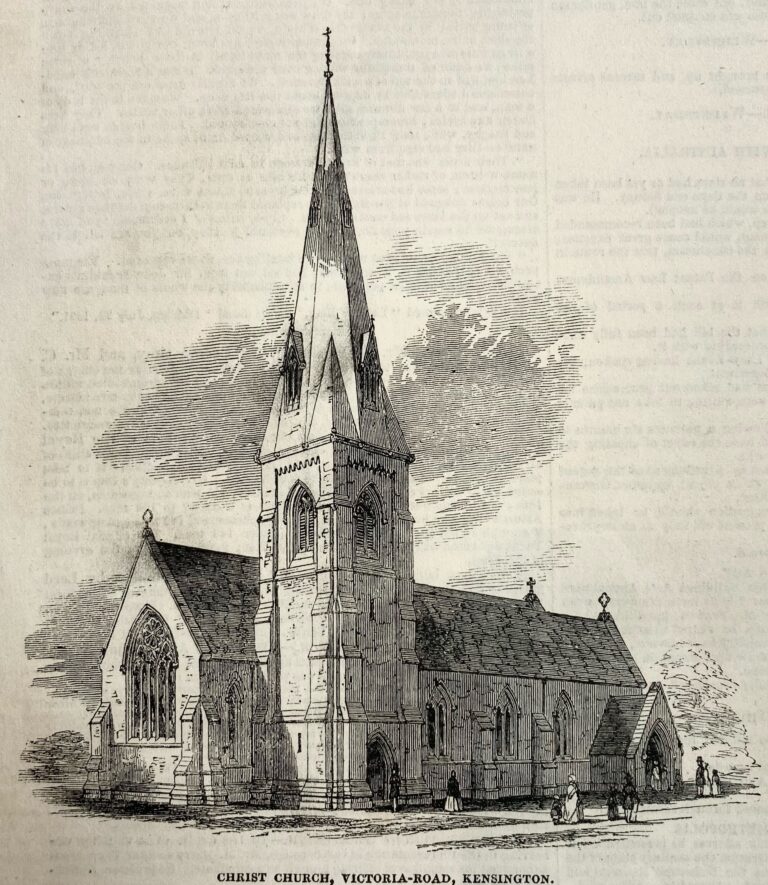
Locals say that Christ Church was built so that the servants of the increasingly smart Victorian residents would stop clogging up St Mary Abbots. It’s true that by the 1850s, Kensington’s historic parish church was getting tight on space (it was rebuilt in 1872). But Christ Church was also planned with its own role at the heart of a fledgling development called Kensington New Town. Until the 1830s, this area below the south east corner of Hyde Park was predominantly rural. Several large houses lined the south side of Kensington Road but behind them, fields and market gardens stretched down to the villages of Earl’s Court, Brompton and Chelsea. Over the next 50 years, the area was transformed as the local landowners joined the London building boom. First, the Vallotton family laid out plans for the development of Victoria Road (then an old country road called Love Lane) in 1829, although building didn’t start in earnest until the 1840s. Meanwhile, in 1836 John Inderwick, a tobacconist from Carnaby Street, bought seven acres between Gloucester Road and Love Lane, and set a faster pace. A tablet formerly attached to the wall of No. 23 Launceston Place attested: “First brick laid on this estate at 3 Canning Place, Feby 1837. The last at this cottage June 1843.” As the developments expanded, plans for a new centre, distinct from Kensington itself, developed with shops and amenities and its own church.
HL Vallotton bequeathed the land for Christ Church, no doubt with some gentle persuasion from the Vicar of St Mary Abbots, the indomitable John Sinclair who established 14 new churches in his parish in his time. The architect was Benjamin Ferrey (1810-1880), a pupil of the elder Augustus Pugin. Ferrey was highly regarded in his day; his many church projects included the restoration of Wells Cathedral. The builder was a Mr Myers who, the records show, submitted the lowest of 10 bids at a total of £3,540. The first stone was laid by the Vicar on 24th July 1850 and exactly a year – and £5,000 – later, the church was consecrated. The Illustrated London News described the building as a “very neat design”, particularly noting the diaper pattern of the east window “copied from York Minster”. It reported: “The church was well filled on the day of consecration, in spite of the unfavourable state of the weather. An excellent sermon was preached by the Bishop from St John 10:19, which realised a collection towards the building fund of £120.” The article also records that the communion plate was given by J J Merriman (1774-1839), third generation occupant of 45 Kensington Square, who was a doctor and “Apothecary Extraordinary” to Queen Victoria. The altar chairs were donated by WF Wolley of Campden House, one of the three great houses of Kensington.
The church remained almost unaltered for 160 years, apart from repairs. But at the centenary celebrations in 1951, Rev Robert Watson, the priest-in-charge, remarked: “I feel justified in mentioning that probably considerably more has been spent on repairs to the valley gutters and on damage resulting from leakage therefrom than the original cost of the building.” During WW2 the spire was taken down in 1941 and lay in the church garden until after the war. Rev Watson recalled personally inspecting the damaged spire: “One could see daylight through the stones at the top (I went up with the steeplejacks to see.) It was found that the cock had what appeared to be two bullet holes, one through his neck the other through his tail. This may have happened some time earlier when there was a “dog fight” above Christ Church during the 12 o’clock service one Sunday morning. The enemy plane came down in Victoria. We kept on with the service.” The repair bill required a different type of stoicism and the post-War years were characterised by valiant and repeated efforts to shore up the building and the church finances. There were several attempts to close the church, including one in the late 1960s when Sir Herbert Andrew, who was also Permanent Secretary at the Dept of Education, resigned as church warden declaring that it was “goodbye anyway” for everyone as closure was imminent. However, locals rallied and economic measures were introduced including one, in the 1970s, when “it was suggested that the lights be turned off during the sermon.” Throughout the turbulence, it was the tireless work of locals – many of whom are still regulars – that ensured the church stayed open.
The arrival of a new ministry team in 2011 brought fresh energy and growth, and in 2017, after 150 years under the wing of St Mary Abbots, Christ Church became a parish in its own right for the first time.
Since then, the church has undertaken three major building projects: in 2015, the redevelopment of the back of the church to install a gallery for more seating, meeting rooms, an industrial kitchen and new lavatories; in 2017, a floor with a rising stage at the front for school assemblies and concerts; and in 2025 a full restoration of the tower and spire. The improvements have not just ensured Christ Church’s structural integrity, but have enabled greater use of the building on Sundays and throughout the week, by the church family and the local community.
Continuing on this trend, our next project (aiming for 2027) will be to replace the pews with flexible seating, underfloor heating and better sound-proofing. This will create much needed space for the church to grow, not least in usefulness to the parish we serve.